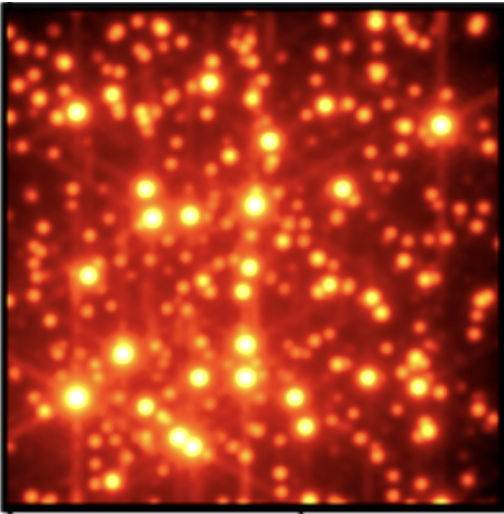
Resolved Stellar Populations
HARMONI will transform our ability to study individual stars in galaxies beyond the Milky Way. By combining the unprecedented angular resolution of the ELT with adaptive optics and integral field spectroscopy, HARMONI will resolve crowded stellar fields and obtain spectra of individual stars in environments that are currently inaccessible.
This capability enables direct measurements of stellar ages, chemical abundances, and kinematics in nearby galaxies, providing a fossil record of galaxy formation and evolution. Such observations are essential for understanding how galaxies assemble their stellar mass and how their stellar populations evolve over cosmic time.
Nearby Galaxies and Black Holes
HARMONI will provide unprecedented insight into the internal structure and dynamics of nearby galaxies. Spatially resolved spectroscopy will allow detailed measurements of stellar and gas kinematics, enabling precise determinations of galaxy mass distributions and the role of dark matter.
A key application is the study of supermassive black holes in galaxy centres. HARMONI’s angular resolution will allow astronomers to probe the gravitational sphere of influence of black holes in a wide range of galaxies, leading to more accurate black hole mass measurements and a deeper understanding of black hole–galaxy co-evolution.

High-Redshift Universe
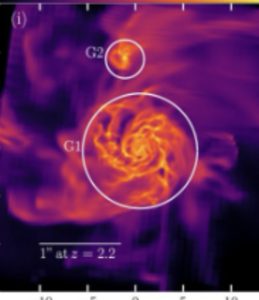
HARMONI will open a new window on galaxy formation in the early Universe. At high redshift, galaxies are compact, turbulent, and rapidly evolving, requiring both high angular resolution and detailed spectroscopic diagnostics.
With HARMONI, astronomers will map the internal kinematics, chemical abundances, and star-formation properties of galaxies during the peak epoch of cosmic star formation and into the era of reionisation. These observations will provide critical constraints on models of galaxy assembly, feedback, and the growth of structure in the Universe.

Our Solar System
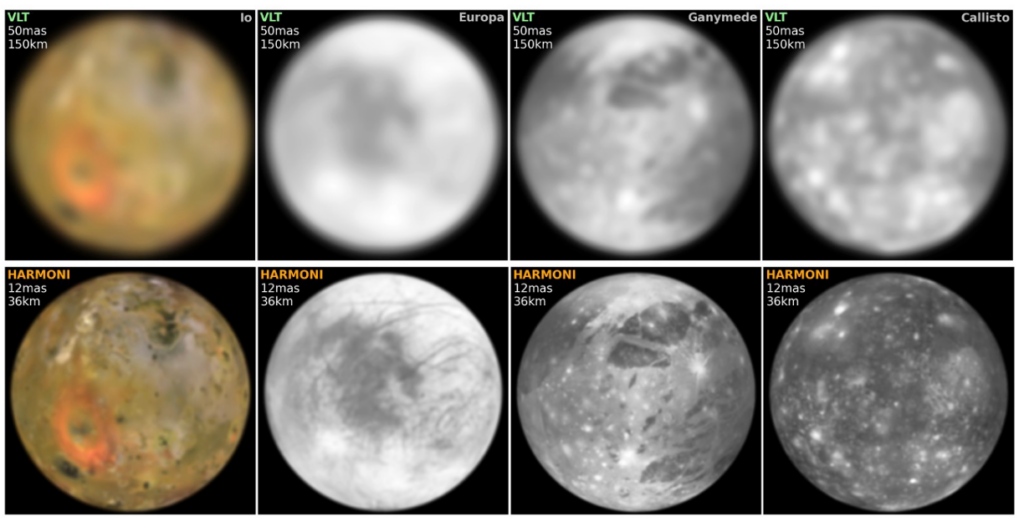
HARMONI will enable spatially resolved spectroscopy of Solar System bodies at unprecedented angular resolution. By combining adaptive optics with integral-field spectroscopy, it will probe the surface composition, atmospheres, and activity of planets, moons, asteroids, and comets.
These observations will provide key insights into planetary formation processes, surface evolution, and the links between Solar System bodies and exoplanetary systems, establishing HARMONI as a powerful tool for comparative planetology.
Exoplanets
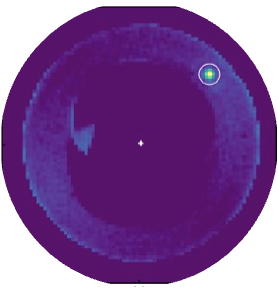
HARMONI will provide high-contrast, spatially resolved spectroscopy of exoplanets, enabling direct measurements of their atmospheres, compositions, and dynamics. By characterising young and nearby planets at high angular resolution, HARMONI will offer critical insights into planet formation and evolution beyond the Solar System.
Transient Universe
HARMONI will deliver rapid, spatially resolved spectroscopy of transient phenomena such as supernovae and their environments. These observations will reveal the physical conditions, progenitor systems, and feedback processes associated with explosive events, providing key insights into the dynamic Universe.