The HARMONI Instrument
HARMONI is the first-light integral-field spectrograph for the Extremely Large Telescope (ELT). It is designed to fully exploit the unprecedented collecting area and angular resolution of the 39-m telescope, delivering spatially resolved spectroscopy from the Solar System to the most distant galaxies.
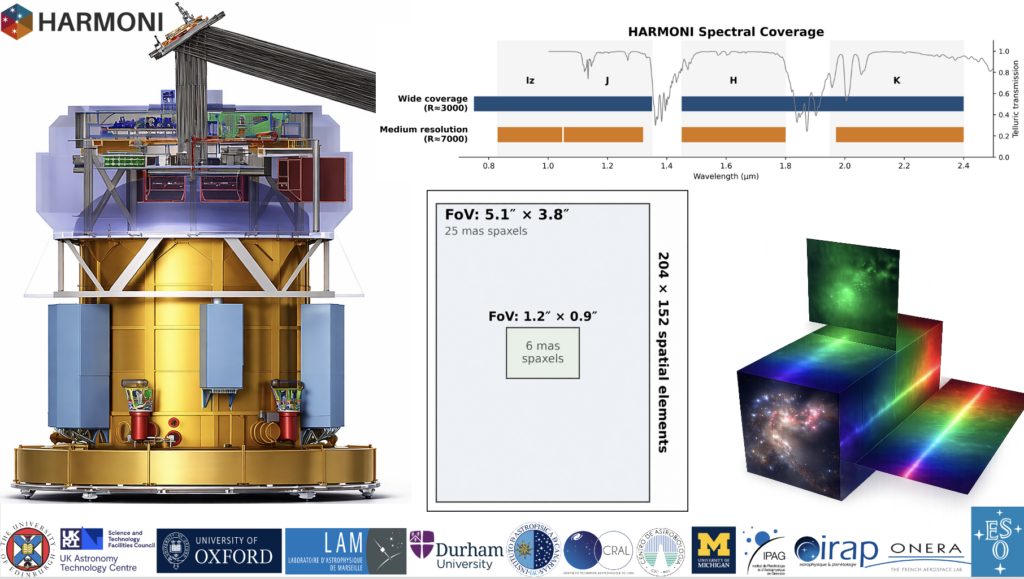
At the heart of HARMONI lies the combination of advanced adaptive optics correction and a powerful near-infrared integral-field spectrograph, allowing astronomers to simultaneously obtain images and spectra over a wide range of spatial scales and spectral resolutions.
Adaptive Optics with HARMONI
Observations from the ground are fundamentally limited by atmospheric turbulence, which distorts incoming wavefronts and blurs astronomical images. On an ELT-sized aperture, correcting these effects is essential to reach diffraction-limited performance and to unlock the full scientific potential of the telescope.
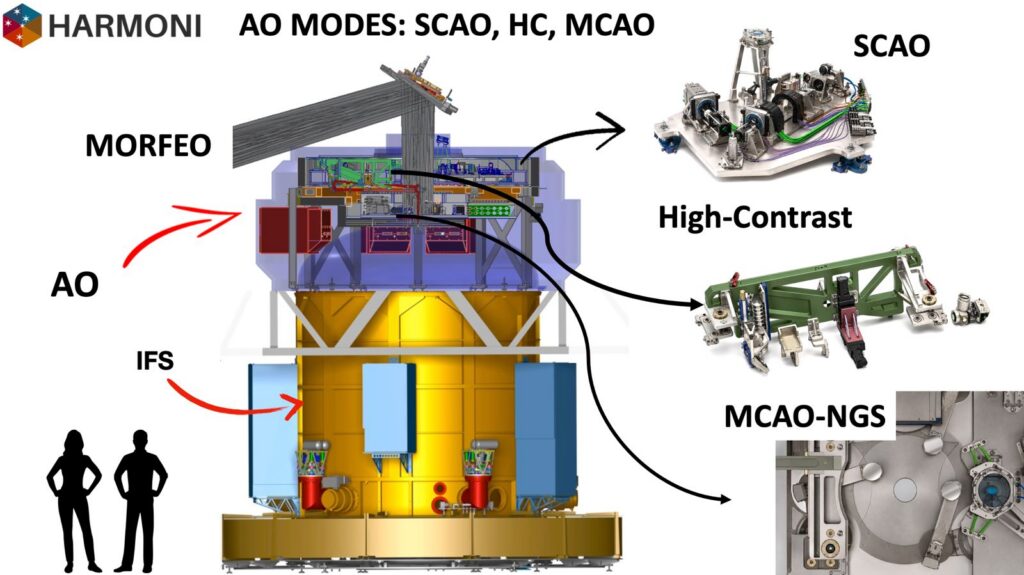
HARMONI operates in conjunction with the ELT adaptive optics systems, providing corrected wavefronts tailored to the science requirements of the instrument. In particular, HARMONI benefits from single conjugate adaptive optics (SCAO) and multi-conjugate adaptive optics (MCAO) provided by MORFEO, which delivers a stable and uniform correction across the instrument field of view.
This adaptive optics correction enables HARMONI to routinely achieve angular resolutions of a few tens of milliarcseconds in the near-infrared, with even finer performance under optimal conditions. Such resolution is critical for resolving crowded stellar fields, probing galactic nuclei, separating compact sources from their environments, and studying small-scale structures in distant galaxies.
HARMONI can also operate in configurations optimised for different observing conditions and science goals, with a dedicated High Contrast Mode dedicated for exoplanets observations.
The HARMONI AO performance can be estimated with TipTop
The Integral Field Spectrograph
HARMONI is an integral-field spectrograph, meaning that it records a spectrum at every spatial position within its field of view. Instead of separating imaging and spectroscopy, HARMONI delivers three-dimensional data cubes, with two spatial dimensions and one spectral dimension.
The spectral range and spectral resolution covered by HARMONI is defined by this table:
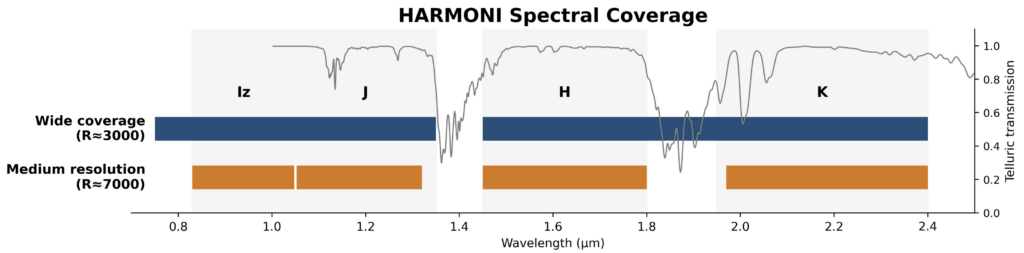

Incoming light from the telescope is spatially sampled by an integral-field unit, which reformats the field of view before dispersing the light with a spectrograph. This approach allows astronomers to reconstruct detailed maps of physical properties such as velocity, chemical composition, and excitation conditions across astronomical sources.
The spectrograph operates in the near-infrared, covering wavelengths that are rich in diagnostic spectral features. Multiple spectral resolution modes are available, enabling observations optimised either for sensitivity to faint sources or for detailed kinematic and chemical analyses.
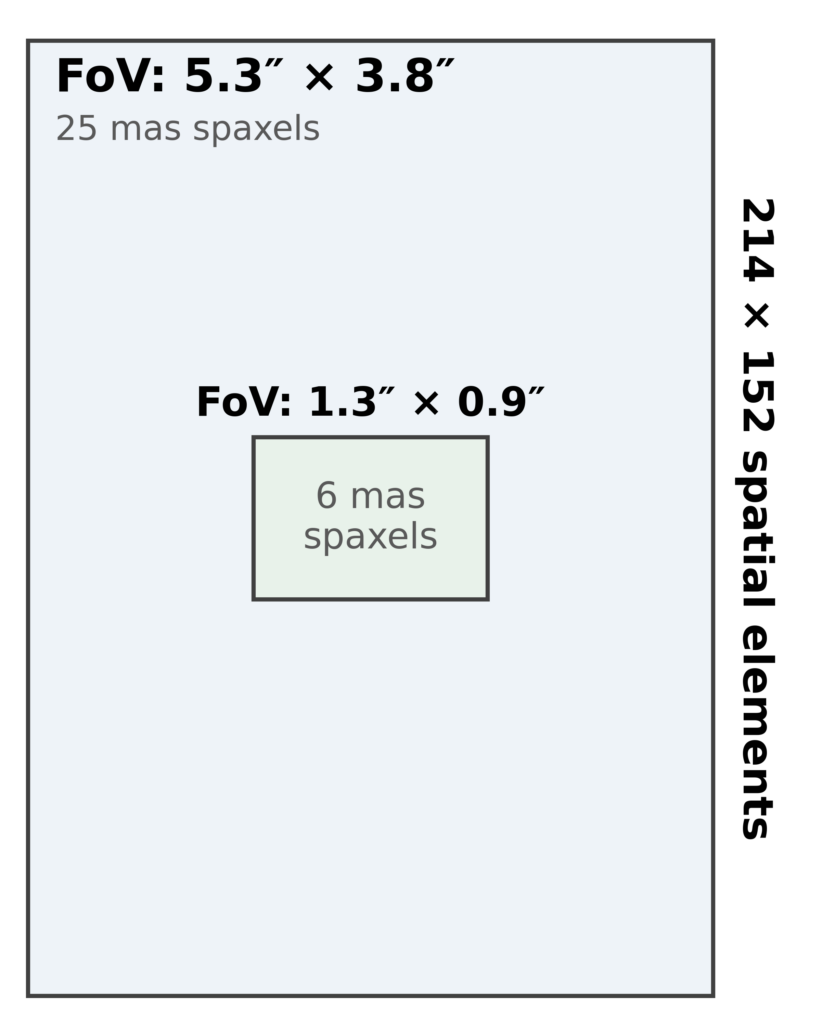
HARMONI’s flexible spatial sampling allows astronomers to choose between very fine spatial scales, fully exploiting adaptive optics correction, and coarser scales that provide a wider field of view and higher efficiency for extended or low-surface-brightness targets. This adaptability makes HARMONI equally powerful for studies of nearby resolved objects and distant unresolved systems.
A fully integrated instrument
The strength of HARMONI lies in the tight integration between adaptive optics and spectroscopy. High-quality wavefront correction ensures that light is concentrated into the smallest possible spatial elements, maximising sensitivity and contrast, while the integral-field spectrograph captures the full spatial and spectral complexity of the target in a single observation.
Together, these capabilities make HARMONI a versatile and transformative instrument, capable of addressing a broad range of scientific questions across astronomy and planetary science, and establishing a new standard for spatially resolved spectroscopy in the ELT era.